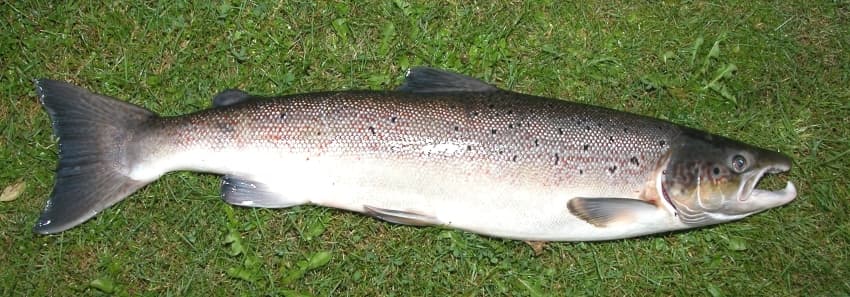
Atlantic Salmon
Salmo salar
Photo: User:Wolfgang Striewski · Public domain · via Wikimedia Commons
Keep or release?
Where are you fishing?
Size limits, seasons and female rules are set by each state. Pick yours to get a verdict.
TIDE covers New Jersey, Pennsylvania and Maryland rules, plus federal protections everywhere.
Verifying against GBIF…
Conservation status
IUCN Red ListMoved to Near Threatened in the December 2023 assessment after a roughly 23% global decline. Wild Atlantic salmon in the Gulf of Maine is separately listed as endangered under US law.
What Near Threatened means
Close to qualifying for a threatened category, or likely to qualify in the near future.
On your plate
Common Seafood
Almost every Atlantic salmon sold is farmed — wild Atlantic salmon fisheries are closed across most of the species' range. Farm type is what separates a good choice from a poor one.
Regional fishing status
Wild populations are declining and largely closed to fishing. Commercial supply comes from net-pen and land-based aquaculture in Norway, Chile, Scotland and Canada.
If you buy it
- Land-based or recirculating aquaculture has the lowest escape and effluent risk.
- Wild Alaska salmon — sockeye, pink, coho — comes from well-managed fisheries.
- Look for ASC or BAP certification on farmed fillets.
Conservation status and seafood sustainability are two different questions. A species can be Least Concern globally and still be overfished, protected or unsustainable where you are.
Habitat
Born in rivers, matures at sea, returns to freshwater to spawn
Range
North Atlantic — eastern North America, Iceland, and Europe from Portugal to Russia
Size
Typically 70–90 cm, up to 30 kg
Diet
Insects and invertebrates as juveniles; fish, squid and shrimp at sea
Lifespan
4–6 years, sometimes longer
Group
fish
Unlike Pacific salmon, Atlantic salmon can survive spawning and return to sea to breed again.
They navigate back to their natal river using Earth's magnetic field, then smell their way to the exact spawning reach.
Salmon carry marine nutrients upriver — bears, birds and even streamside forests measurably depend on that delivery.
Cook this species