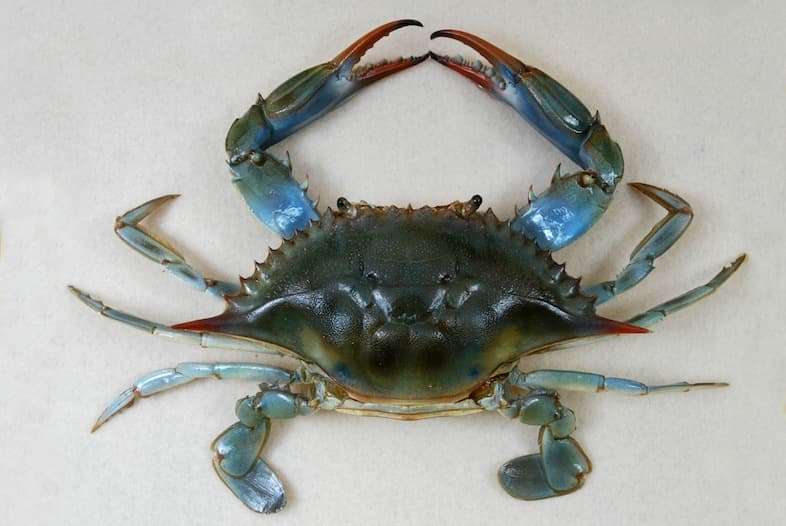
Blue Crab
Callinectes sapidus
Photo: CC BY-SA 3.0 · via Wikimedia Commons
Keep or release?
Where are you fishing?
Size limits, seasons and female rules are set by each state. Pick yours to get a verdict.
TIDE covers New Jersey, Pennsylvania and Maryland rules, plus federal protections everywhere.
Verifying against GBIF…
Conservation status
IUCN Red ListFemales carry an average of about 3 million eggs in each brood under the apron, which is why an egg-carrying 'sponge' crab always goes back.
What Not Evaluated means
No global Red List assessment exists. Regional stock assessments are the better guide for this species.
On your plate
Common Seafood
A well-known regional fishery with active management. Population swings are sharp, so local guidance changes year to year.
Regional fishing status
The Chesapeake Bay winter dredge survey sets management each year. The 2022 survey recorded the lowest abundance in its history and triggered tighter limits on female harvest.
If you buy it
- US blue crab is generally a solid choice; check current state guidance for the season.
- Much canned 'crab meat' sold in the US is imported swimming crab, not blue crab.
- Soft-shell crabs are blue crabs harvested right after they moult.
Conservation status and seafood sustainability are two different questions. A species can be Least Concern globally and still be overfished, protected or unsustainable where you are.
Habitat
Estuaries, bays, salt marshes and shallow coastal waters
Range
Western Atlantic from Nova Scotia to Argentina; introduced to European and Asian waters
Size
Up to 23 cm across the shell
Diet
Clams, mussels, fish, plants and detritus
Lifespan
3–4 years
Group
crustacean
Callinectes sapidus translates roughly as 'beautiful savoury swimmer' — a rare case of a scientific name doubling as a menu review.
Its rear legs are flattened into paddles, making it one of the few crabs that genuinely swims rather than walks.
A blue crab must shed its entire shell to grow, and for a few hours afterwards it is completely soft — the window that creates soft-shell crab.
Cook this species